How Were Clothes Dyed in Ancient India? — Indigo, Turmeric & Mordants
- Indigo: Complex redox reaction converting colorless Indican to blue Indigotin via fermentation and oxidation.
- Turmeric: A direct dye and pH indicator (Yellow in acid, Red in base) containing Curcumin.
- Mordants: 'Chemical bridges' like Alum and Iron that help dyes bind to fibers.
- Redox Reactions: Indigo dyeing is a classic example of reduction followed by oxidation.
- Sustainability: Ancient natural dyeing techniques are a green alternative to modern synthetic pollutants.
Introduction
Long before the invention of synthetic pigments in 1856, the world was colored by the earth. Ancient civilizations didn't look for colors in test tubes; they looked into roots, leaves, and minerals. Through a sophisticated understanding of fermentation, oxidation, and pH levels, they turned raw nature into "Living Colors" that lasted for centuries.
1. Indigo: The "King of Dyes" (Blue)
Indigo is perhaps the most chemically complex dye of the ancient world, extracted from the leaves of the Indigofera tinctoria plant.
How it worked
Result
2. Turmeric Dyeing (Haldi) – Direct Natural Coloring
How it worked
Chemical nature of Curcumin
Result
3. The Chemistry of Mordants (The "Bridge")
One of the greatest discoveries in ancient chemistry was the Mordant. Most natural dyes cannot stick to cotton or silk on their own — they need a "Chemical Bridge."
What is a Mordant? Derived from the Latin word *mordere* (to bite), these substances "bite" into the fiber and hold the dye molecule in place.
Common Ancient Mordants
4. Modern Connection: The Sustainability Shift
Today, the synthetic dye industry is one of the world's largest water polluters. Modern "Green Chemistry" is looking back at these ancient techniques — using enzymes and bacterial fermentation — to recreate the Indigo process without toxic chemicals.
Ancient wisdom is now the future of sustainable fashion.
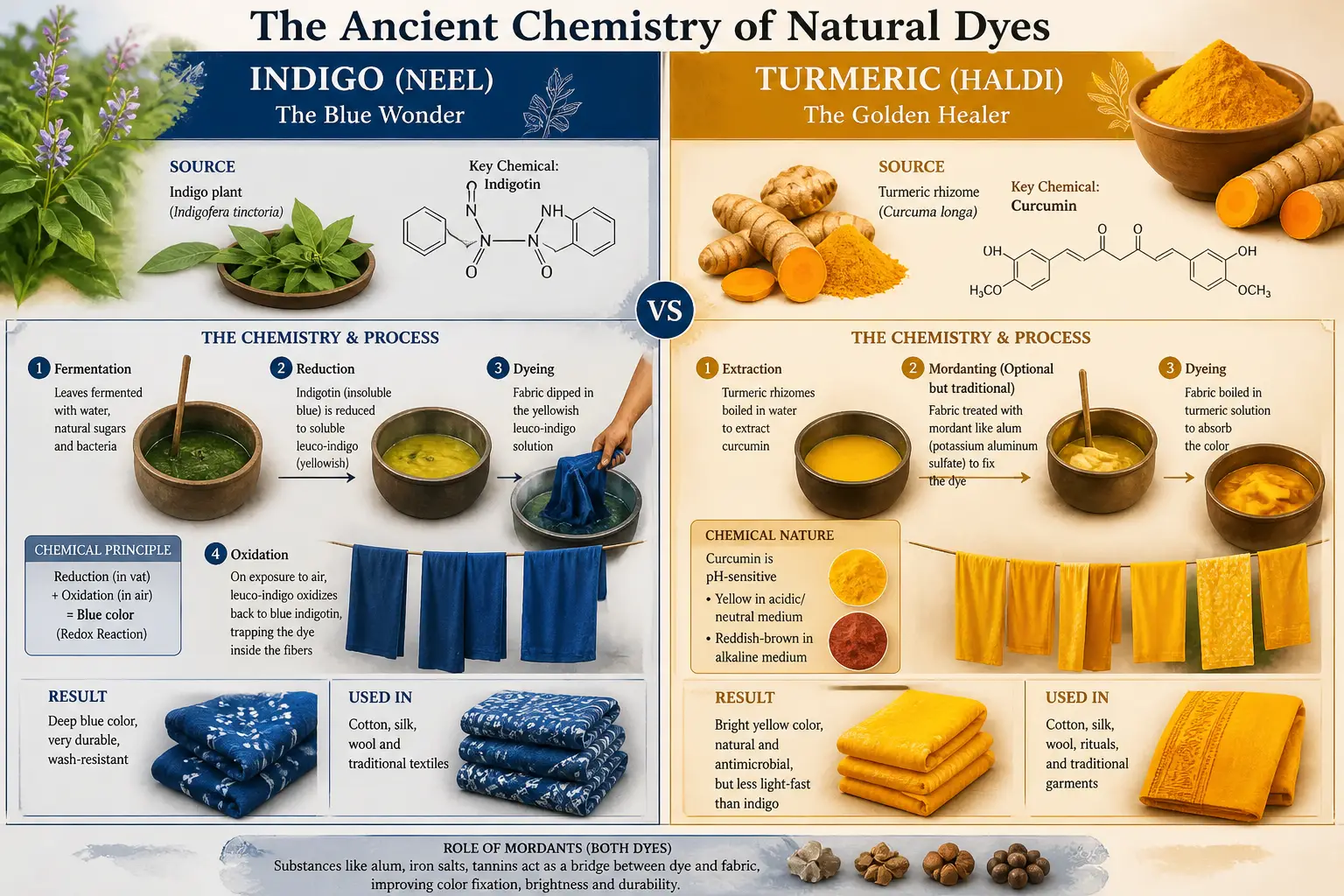
- Indigo: Complex redox reaction converting colorless Indican to blue Indigotin via fermentation and oxidation.
- Turmeric: A direct dye and pH indicator (Yellow in acid, Red in base) containing Curcumin.
- Mordants: 'Chemical bridges' like Alum and Iron that help dyes bind to fibers.
- Redox Reactions: Indigo dyeing is a classic example of reduction followed by oxidation.
- Sustainability: Ancient natural dyeing techniques are a green alternative to modern synthetic pollutants.
Available Files2
These original educational materials were created by Juber Aktar for JAtone. They are hosted on Google Drive or Google Slides for convenient access. Any future advertising will remain outside this file list and separate from the Preview and Download controls.
About How Were Clothes Dyed in Ancient India? — Indigo, Turmeric & Mordants
How Were Clothes Dyed in Ancient India? — Indigo, Turmeric & Mordants is a fundamental concept in ancient chemistry. Understanding the mechanisms, reaction conditions, and stereo-chemical outcomes is crucial for mastering organic chemistry. Our curated resources provide step-by-step visualizations to help you excel.
SELF TEST
Practice MCQs
What chemical transformation makes Indigo dye turn blue when pulled out of a vat?
LEARNING SUPPORT
How
Were Clothes Dyed in Ancient India? — Indigo, Turmeric & Mordants FAQ
Indigo was known as the 'King of Dyes' because it produced a deep, royal blue that was exceptionally durable and wash-resistant. Its complex chemical extraction process and the magical-seeming oxidation (turning from yellow to blue in air) also added to its prestige.
A mordant (from Latin 'mordere', meaning 'to bite') acts as a chemical bridge between the fabric fiber and the dye molecule. Most natural dyes like turmeric or madder cannot stick to cotton on their own; the mordant 'bites' into both, making the color permanent.
Not entirely. While turmeric (Curcumin) provides a very bright yellow, it is sensitive to sunlight (photodegradation) and washing. Ancient dyers used natural fixatives, but turmeric-dyed clothes generally faded faster than indigo-dyed ones.