Types of Solvents: Polar and Non-Polar
- Polar solvents dissolve ionic and polar substances.
- Non-polar solvents dissolve non-polar substances.
- Like dissolves like.
Types of Solvents
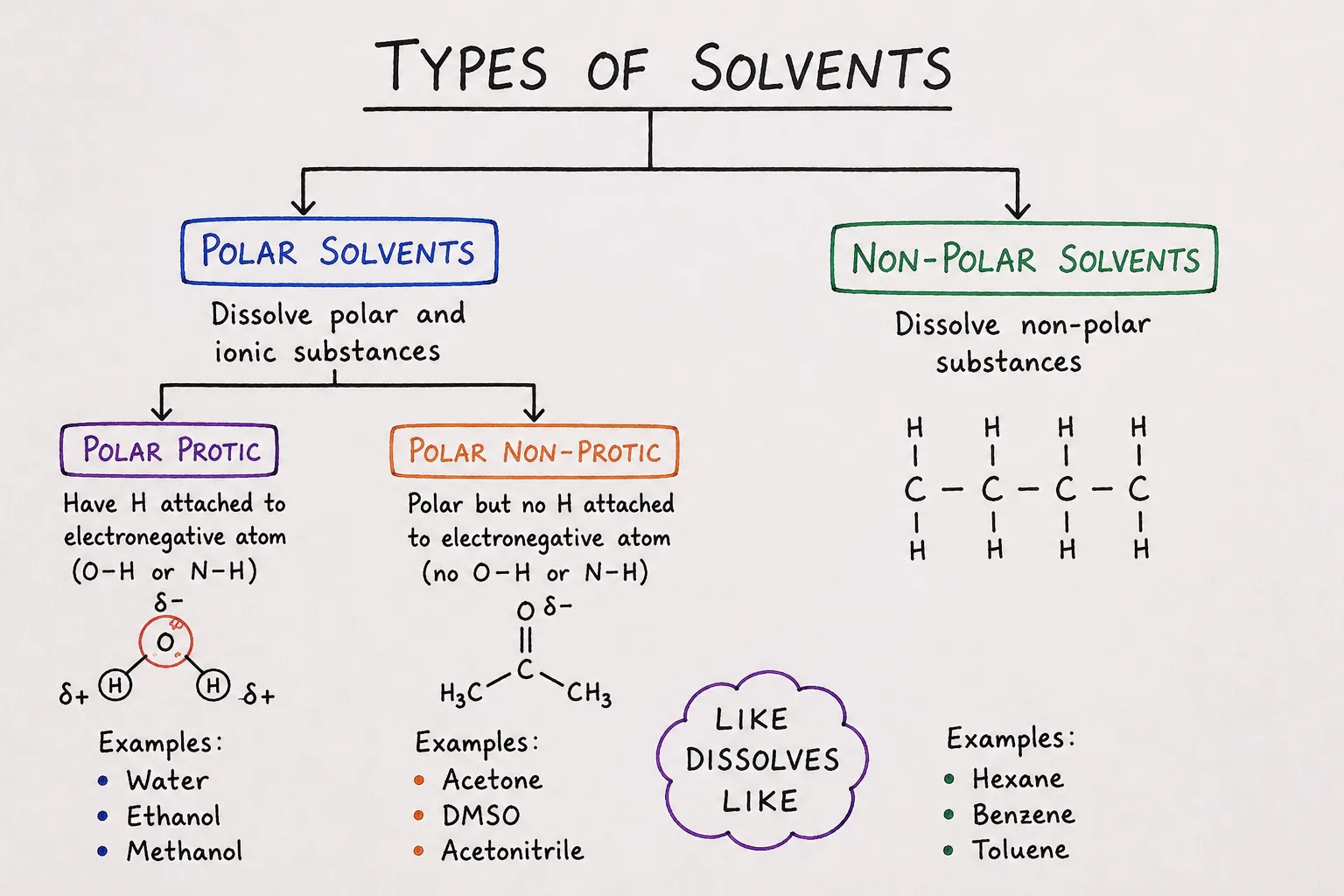
What is a Solvent?
A solvent is a substance that dissolves a solute to form a solution. It is usually present in a larger amount than the solute.
Solution = Solvent + Solute
For example, in saltwater — water is the solvent and salt (NaCl) is the solute.
Classification of Solvents
Solvents are commonly classified into two main types based on their polarity:
1. Polar Solvents
These solvents have molecules with uneven charge distribution (high dipole moment) and can dissolve ionic and polar substances.
Examples:
Types of Polar Solvents:
a) Polar Protic Solvents
b) Polar Aprotic Solvents
2. Non-Polar Solvents
These solvents have an even charge distribution (low or zero dipole moment) and dissolve non-polar substances.
Examples:
Properties of a Good Solvent
| Property | Description |
|---|---|
| High dissolving power | Should dissolve a wide range of solutes |
| Chemical inertness | Should not react with the solute |
| Low toxicity | Should be safe to handle |
| Low boiling point | Easy to remove after use |
| Cheap & available | Should be economically practical |
| Non-flammable | Safer for industrial use |
Dielectric Constant of Common Solvents
The dielectric constant (ε) measures how well a solvent can reduce the force between opposite charges. Higher value = more polar.
| Solvent | Dielectric Constant (ε) | Type |
|---|---|---|
| Water | 80.1 | Polar protic |
| Methanol | 33.0 | Polar protic |
| Ethanol | 24.6 | Polar protic |
| Acetone | 21.0 | Polar aprotic |
| DMSO | 46.7 | Polar aprotic |
| Acetonitrile | 37.5 | Polar aprotic |
| Benzene | 2.3 | Non-polar |
| Hexane | 1.9 | Non-polar |
Effect of Solvent on Reaction Type
| Reaction | Preferred Solvent | Reason |
|---|---|---|
| SN1 | Polar protic (e.g., Water, Ethanol) | Stabilizes carbocation intermediate |
| SN2 | Polar aprotic (e.g., DMSO, Acetone) | Does not block nucleophile |
| Ionic reactions | Polar solvents | Dissolve ions well |
| Non-polar reactions | Non-polar solvents (e.g., Hexane) | Like dissolves like |
Real-Life Applications of Solvents
Summary Table
| Type | Characteristics | Examples |
|---|---|---|
| Polar protic | Hydrogen bonding, dissolve salts | Water, Ethanol, Methanol |
| Polar aprotic | Polar but no hydrogen bonding | Acetone, DMSO, DMF |
| Non-polar | Dissolve oils, fats, waxes | Hexane, Benzene, Toluene |
Key Points to Remember
- Polar solvents dissolve ionic and polar substances.
- Non-polar solvents dissolve non-polar substances.
- Like dissolves like.
About Types of Solvents: Polar and Non-Polar
Types of Solvents: Polar and Non-Polar is a fundamental concept in organic chemistry. Understanding the mechanisms, reaction conditions, and stereo-chemical outcomes is crucial for mastering organic chemistry. Our curated resources provide step-by-step visualizations to help you excel.
SELF TEST
Practice MCQs
Which type of solvent can dissolve ionic and polar compounds?
LEARNING SUPPORT
Types
of Solvents: Polar and Non-Polar FAQ
Polar protic solvents contain O-H or N-H bonds and can form hydrogen bonds (like water and ethanol). Polar aprotic solvents do not contain these bonds and cannot form hydrogen bonds, though they are still polar (like acetone and DMSO).
It is a general rule in chemistry meaning that polar solvents are best at dissolving polar and ionic substances, while non-polar solvents are best at dissolving non-polar substances.
Common examples of non-polar solvents include benzene, hexane, toluene, and carbon tetrachloride.