Functional Groups in Organic Chemistry: Chart, List & Notes PDF
IUPAC name determined by highest-priority functional group
Carbonyl (C=O): aldehyde at chain end; ketone within
–COOH most acidic; –NH₂ basic; –OH hydrogen-bonds
Same group → same reactivity, regardless of chain size
Biological function: life depends on specific group interactions
Functional Groups: The Molecular Signature of Organic Compounds
Functional groups are specific clusters of atoms within organic molecules that determine the chemical behavior and properties of those compounds.
They are the "functional" part of the molecule, where most chemical reactions occur. Understanding these groups is essential for mastering organic chemistry, as they allow us to predict reactivity, physical properties, and nomenclature.
1. Hydrocarbons (Carbon and Hydrogen Only)
While alkanes are relatively inert, other hydrocarbons contain reactive functional groups:
Alkenes (C=C): Contain at least one carbon-carbon double bond. They are unsaturated and undergo addition reactions.
Alkynes (C≡C): Contain at least one carbon-carbon triple bond. Highly reactive and follow distinct addition patterns.
Aromatics (Arenes): Contain a benzene-like ring (e.g., benzene, toluene). They possess unique stability through resonance.
2. Oxygen-Containing Functional Groups
These groups significantly influence a molecule's polarity and solubility:
Alcohols (–OH): Contain a hydroxyl group. They can form hydrogen bonds and are often water-soluble.
Ethers (R–O–R'): Contain an oxygen atom bonded to two alkyl or aryl groups. Generally less reactive than alcohols.
Aldehydes (R–CHO): Feature a carbonyl group (C=O) at the end of a carbon chain.
Ketones (R–CO–R'): Feature a carbonyl group (C=O) within the carbon chain.
Carboxylic Acids (–COOH): Contain a carboxyl group (carbonyl + hydroxyl). They are acidic and have high boiling points.
Esters (R–COO–R'): Formed by the reaction of a carboxylic acid and an alcohol. Known for their pleasant fruity odors.
3. Nitrogen-Containing Functional Groups
Amines (–NH₂, –NHR, –NR₂): Derivatives of ammonia. They are basic and found in proteins and DNA.
Amides (–CONH₂, –CONHR, –CONR₂): Derived from carboxylic acids and amines. Essential for forming peptide bonds in proteins.
Nitriles (–C≡N): Contain a cyano group. Useful in synthesis and found in various synthetic materials.
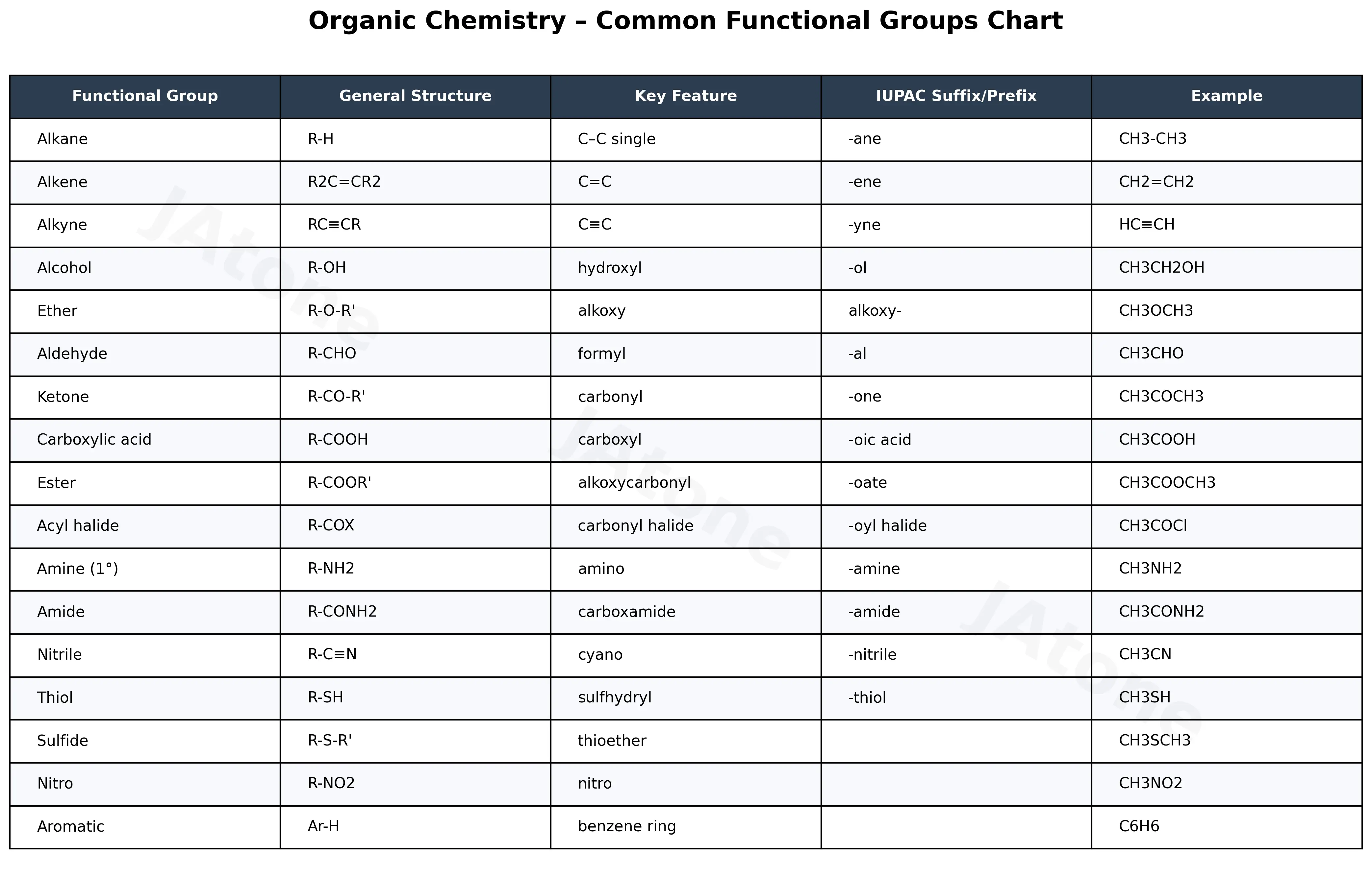
Functional Group Summary Chart
The chart above provides a visual overview of the major functional groups, their structural formulas, and examples.
Why Do Functional Groups Matter?
Chemical Reactivity: The same functional group will undergo similar chemical reactions, regardless of the size of the rest of the molecule.
Physical Properties: Groups like hydroxyl (–OH) or carboxyl (–COOH) increase boiling points and water solubility through hydrogen bonding.
Nomenclature: IUPAC naming rules are strictly based on the principal functional group present in the molecule.
Biological Function: Life depends on the specific interactions between functional groups in carbohydrates, lipids, proteins, and nucleic acids.
IUPAC name determined by highest-priority functional group
Carbonyl (C=O): aldehyde at chain end; ketone within
–COOH most acidic; –NH₂ basic; –OH hydrogen-bonds
Same group → same reactivity, regardless of chain size
Biological function: life depends on specific group interactions
Contents
Available Files6
These original educational materials were created by Juber Aktar for JAtone. They are hosted on Google Drive or Google Slides for convenient access. Any future advertising will remain outside this file list and separate from the Preview and Download controls.
About Functional Groups in Organic Chemistry: Chart, List & Notes PDF
Functional Groups in Organic Chemistry: Chart, List & Notes PDF is a fundamental concept in organic chemistry. Understanding the mechanisms, reaction conditions, and stereo-chemical outcomes is crucial for mastering organic chemistry. Our curated resources provide step-by-step visualizations to help you excel.
SELF TEST
Practice MCQs
Question 1 / 5Score: 0
Which functional group is present in a carboxylic acid?
LEARNING SUPPORT
Functional Groups in Organic Chemistry: Chart, List & Notes PDF FAQ
Functional groups dictate the chemical reactivity, polarity, acidity/basicity, and the types of intermolecular forces the molecule can engage in, largely ignoring the rest of the carbon backbone.
In IUPAC nomenclature, the highest priority group determines the suffix. The order generally is: Carboxylic acids > Esters > Amides > Nitriles > Aldehydes > Ketones > Alcohols > Amines.
Both contain a carbonyl group (C=O). In an aldehyde, the carbonyl carbon is attached to at least one hydrogen atom (meaning it's at the end of the chain). In a ketone, the carbonyl carbon is attached to two other carbon atoms (meaning it's within the chain).