Ester Hydrolysis MechanismsAlkaloids OverviewAlkaloid Structure MethodsStructure Elucidation of NicotineIntroduction to DrugsClassification of Drugs: PharmacodynamicsWhy Do We Take Paracetamol in Fever?Types of SolventsSustainable SolventsNucleophile and ElectrophileReactions of MaltoseFunctional GroupsSN1 and SN2 ReactionsGrignard ReagentE1 and E2 Elimination
Corrosion OverviewVSEPR TheoryBond Angle Deviations in VSEPRVSEPR Theory and Molecular PolarityLewis Structures, Formal Charge & ResonanceLewis Dot StructureSuperacids and Liquid AmmoniaTypes of ReactionsAdvanced Types of ReactionsPeriodic Trends (Periodicity)Hydrogen BondingRoasting and CalcinationRelativistic Effects in Heavy Metals
Ajanta Cave PaintingsChemical Principles of Food PreservationAncient Indian Methods of Food PreservationChemicals Used in Food PreservationHow were clothes dyed?Ancient Indian Glass and Ceramic TechnologyAncient Indian MetallurgyAncient Chemistry of Cosmetics & Perfumery
Conductometric Titration: Strong Acid vs. Strong BaseArrhenius EquationQuantum YieldStates of MatterWeston Standard CellElectrochemistry
Chemistry Studio
Functional Group ExplorerChemical Structure Editor

JAtone.

Notes & guides

Learn
Ester Hydrolysis MechanismsAlkaloids OverviewAlkaloid Structure MethodsStructure Elucidation of NicotineIntroduction to DrugsClassification of Drugs: PharmacodynamicsWhy Do We Take Paracetamol in Fever?Types of SolventsSustainable SolventsNucleophile and ElectrophileReactions of MaltoseFunctional GroupsSN1 and SN2 ReactionsGrignard ReagentE1 and E2 Elimination
Corrosion OverviewVSEPR TheoryBond Angle Deviations in VSEPRVSEPR Theory and Molecular PolarityLewis Structures, Formal Charge & ResonanceLewis Dot StructureSuperacids and Liquid AmmoniaTypes of ReactionsAdvanced Types of ReactionsPeriodic Trends (Periodicity)Hydrogen BondingRoasting and CalcinationRelativistic Effects in Heavy Metals
Ajanta Cave PaintingsChemical Principles of Food PreservationAncient Indian Methods of Food PreservationChemicals Used in Food PreservationHow were clothes dyed?Ancient Indian Glass and Ceramic TechnologyAncient Indian MetallurgyAncient Chemistry of Cosmetics & Perfumery
Conductometric Titration: Strong Acid vs. Strong BaseArrhenius EquationQuantum YieldStates of MatterWeston Standard CellElectrochemistry
Chemistry Studio
Functional Group ExplorerChemical Structure Editor

JAtone.

Notes & guides

Learn
J
JAtone
Homephysical chemistry
|

Weston Standard Cell

  • A standard cell provides a constant, accurate, and reproducible EMF.
  • The Weston Standard Cell uses a Cadmium Amalgam anode and a Mercury/Mercurous Sulphate cathode.
  • Saturated cells have excess CdSO₄·8/3H₂O crystals; unsaturated cells do not.
  • EMF of a saturated cell is 1.0183 V at 20°C.
  • The cell has a very low temperature coefficient.
Weston Standard Cell1. Standard CellCharacteristics of a Standard Cell2. Weston Standard CellTypes3. Construction of Saturated Weston Standard CellConstructionNegative Electrode (Anode)Positive Electrode (Cathode)ElectrolyteConstruction Summary4. Cell Representation5. Cell Reactions(A) At Anode (Oxidation)(B) At Cathode (Reduction)(C) Overall Cell Reaction6. EMF of Weston Standard CellTemperature DependenceTemperature CoefficientMeaning7. Saturated Weston CellCharacteristicsEMF8. Unsaturated Weston CellConstructionCharacteristicsEMF9. Difference Between Saturated and Unsaturated Weston Cell10. Advantages of Weston Standard Cell11. ApplicationsQuick RevisionStandard EMFCell RepresentationAnodeCathodeOverall ReactionTemperature EquationEMF at 20°C

Weston Standard Cell

1. Standard Cell

A standard cell is a primary electrochemical cell that provides a constant, accurate, and reproducible Electromotive Force (EMF). It is used as a reference source of voltage for calibrating electrical instruments and measuring unknown EMF.

Characteristics of a Standard Cell

A standard cell should have:

  • Constant and accurately known EMF.
  • Very low temperature coefficient (EMF changes very little with temperature).
  • Highly reproducible EMF.
  • Reversible cell reaction.
  • Long-term stability.
  • 2. Weston Standard Cell

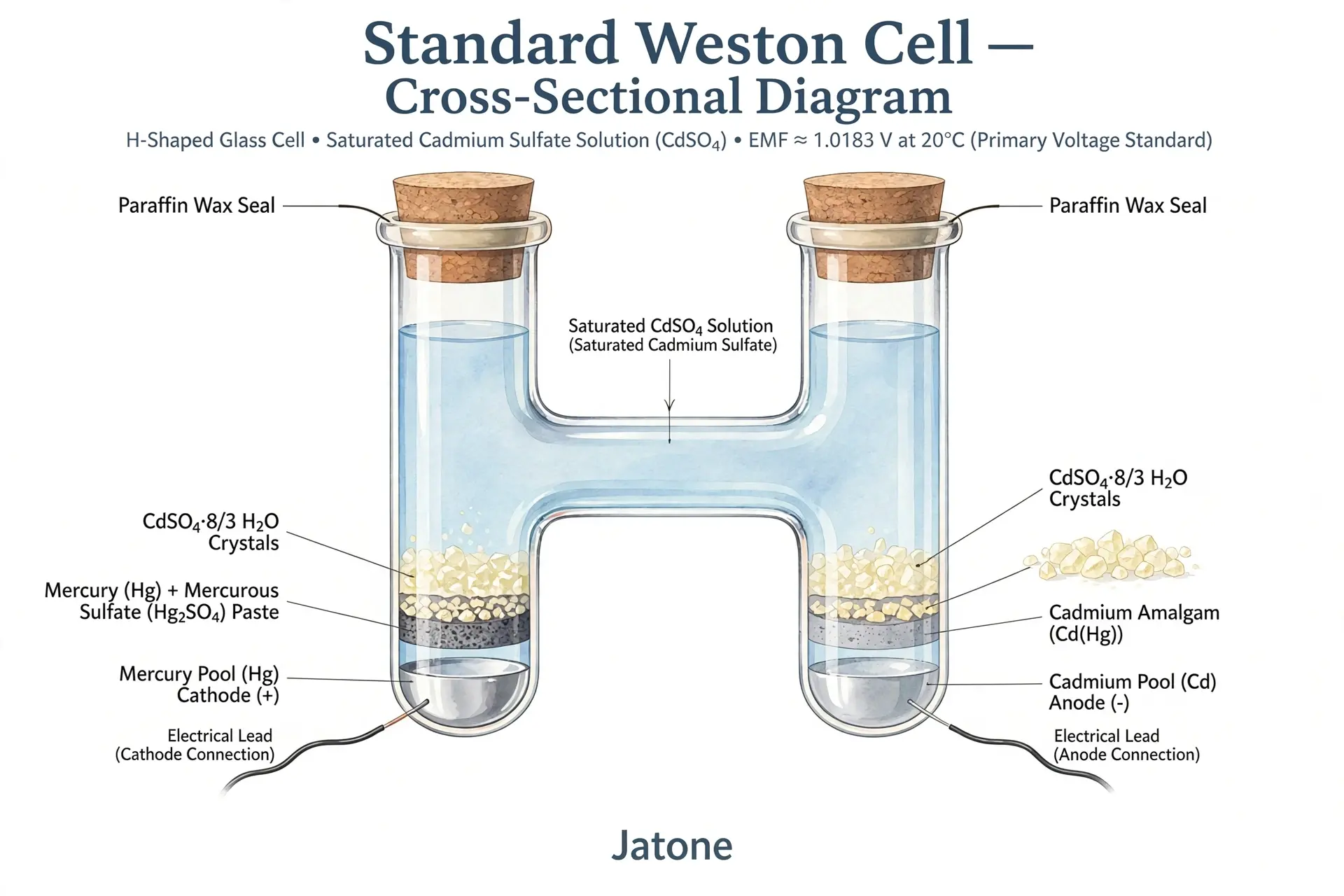
    Weston Standard Cell Real Image

    The Weston Standard Cell (Cadmium Cell) is the most widely used standard cell because its EMF remains almost constant for many years and changes very little with temperature.

    Types

  • 1.Saturated Weston Standard Cell
  • 2.Unsaturated Weston Standard Cell
  • 3. Construction of Saturated Weston Standard Cell
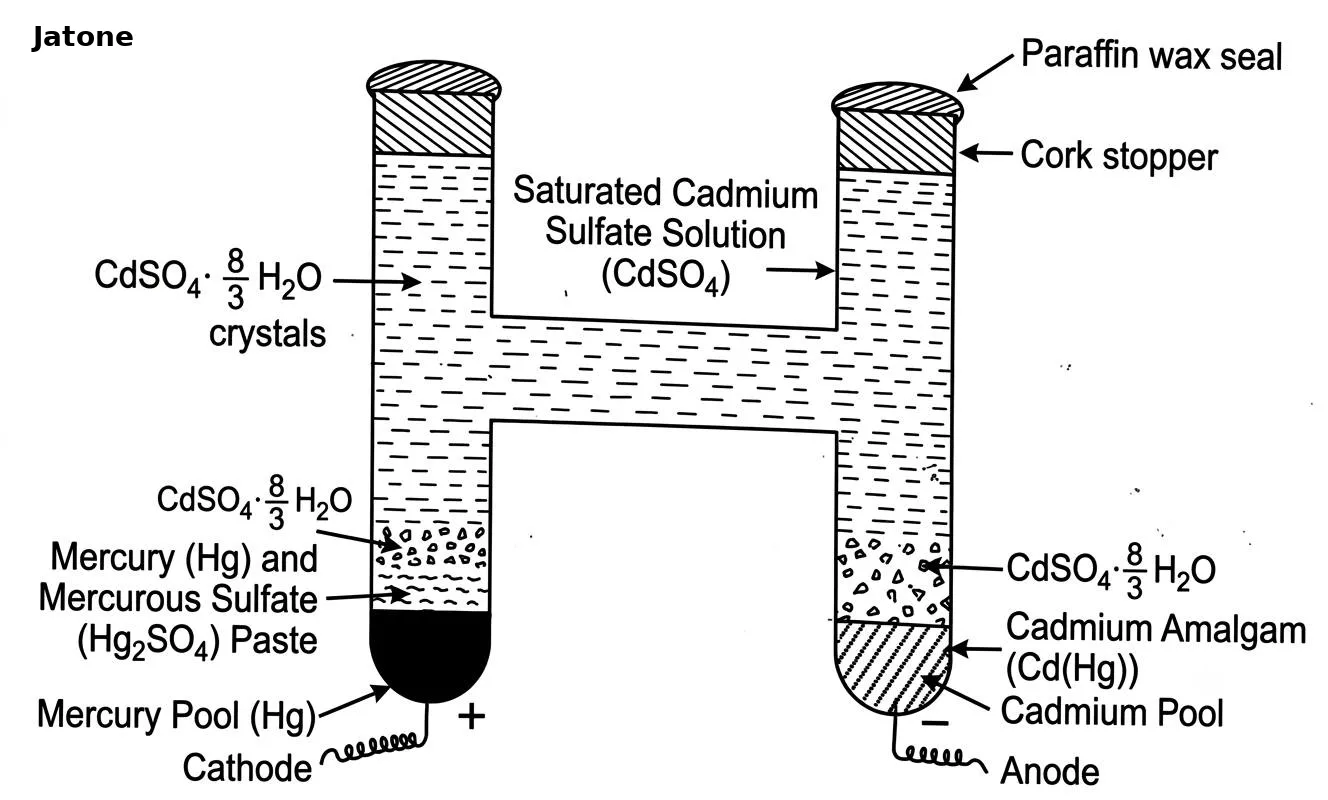
    Weston Standard Cell Diagram

    Construction

  • Constructed in an H-shaped glass tube.
  • The tube is sealed at the top with wax/cork to prevent evaporation and contamination.
  • Platinum wires are sealed at the bottom of both limbs to serve as electrical terminals.
  • Negative Electrode (Anode)

    Contains:

  • 12.5% Cadmium Amalgam (Cd dissolved in Hg)
  • Covered with crystals of hydrated cadmium sulphate
  • CdSO₄ · 83H₂O

    Positive Electrode (Cathode)

    Contains:

  • Pure Mercury (Hg)
  • Covered with a paste of Mercurous Sulphate
  • Hg₂SO₄
  • Above this paste is a layer of hydrated cadmium sulphate crystals.
  • Electrolyte

    The entire H-shaped tube is filled with a saturated solution of Cadmium Sulphate.

    CdSO₄

    Construction Summary

    PartMaterial
    VesselH-shaped glass tube
    Negative electrode12.5% Cadmium amalgam
    Positive electrodeMercury + Mercurous sulphate paste
    ElectrolyteSaturated CdSO₄ solution
    CrystalsCdSO₄·8/3H₂O
    Electrical contactsPlatinum wires

    4. Cell Representation

    Cd(Hg) | CdSO₄·83H₂O(s) | CdSO₄(sat.) | Hg₂SO₄(s) | Hg

    5. Cell Reactions

    (A) At Anode (Oxidation)

    Cadmium loses electrons.

    Cd(Hg) + SO₄²⁻ + 83H₂O → CdSO₄·83H₂O + 2e⁻

    Simplified:

    Cd → Cd²⁺ + 2e⁻

    (B) At Cathode (Reduction)

    Mercurous sulphate gains electrons.

    Hg₂SO₄ + 2e⁻ → 2Hg + SO₄²⁻

    (C) Overall Cell Reaction

    Cd(Hg) + Hg₂SO₄ + 83H₂O → CdSO₄·83H₂O + 2Hg

    6. EMF of Weston Standard Cell

    At 20°C

    E = 1.01830 V

    (Usually written as 1.0183 V.)

    Temperature Dependence

    The EMF at temperature t°C is

    E_t = 1.01830 - 4.06×10⁻⁵(t-20) - 9.5×10⁻⁷(t-20)²

    where,

  • E_t = EMF at temperature t °C
  • t = Temperature in °C
  • Temperature Coefficient

    Approximately

    -4.06×10⁻⁵ V/°C

    Meaning

  • As temperature increases, EMF decreases slightly.
  • The change is extremely small, making the Weston cell highly stable.
  • 7. Saturated Weston Cell

    Characteristics

  • Contains excess solid CdSO₄·8/3H₂O crystals.
  • Electrolyte always remains saturated.
  • Highly stable.
  • Long life.
  • Used as the International Standard Cell.
  • EMF

    1.0183 V at 20°C

    8. Unsaturated Weston Cell

    Construction

    Same as saturated cell except:

  • No excess CdSO₄·8/3H₂O crystals are present.
  • The electrolyte is unsaturated.
  • Characteristics

  • Lower temperature coefficient (almost zero).
  • EMF is slightly higher.
  • EMF slowly decreases with time.
  • Less suitable as an international standard.
  • Commonly used as a laboratory reference cell.
  • EMF

    1.0186 V at 20°C

    9. Difference Between Saturated and Unsaturated Weston Cell

    Saturated Weston CellUnsaturated Weston Cell
    Contains excess CdSO₄·8/3H₂O crystalsNo CdSO₄ crystals
    Electrolyte remains saturatedElectrolyte is unsaturated
    EMF = 1.0183 VEMF ≈ 1.0186 V
    Temperature coefficient is smallTemperature coefficient is almost zero
    Very stable for long periodsEMF slowly decreases with time
    Used as International StandardUsed mainly in laboratories

    10. Advantages of Weston Standard Cell

  • Provides a highly accurate and constant EMF.
  • Very low temperature coefficient.
  • Excellent long-term stability.
  • Reversible cell reaction.
  • Used for calibration of voltmeters, potentiometers, and other electrical measuring instruments.
  • 11. Applications

  • Used as a standard source of EMF.
  • Calibration of potentiometers.
  • Calibration of voltmeters.
  • Calibration of electrical measuring instruments.
  • Measurement of unknown EMF by comparison.
  • Quick Revision

    Standard EMF

    1.0183 V (20°C)

    Cell Representation

    Cd(Hg) | CdSO₄·83H₂O | CdSO₄(sat.) | Hg₂SO₄ | Hg

    Anode

    Cd(Hg) → Cd²⁺ + 2e⁻

    Cathode

    Hg₂SO₄ + 2e⁻ → 2Hg + SO₄²⁻

    Overall Reaction

    Cd(Hg) + Hg₂SO₄ + 83H₂O → CdSO₄·83H₂O + 2Hg

    Temperature Equation

    E_t = 1.01830 - 4.06×10⁻⁵(t-20) - 9.5×10⁻⁷(t-20)²

    EMF at 20°C

  • Saturated Cell: 1.0183 V
  • Unsaturated Cell: 1.0186 V
  • Read next →Conductometric TitrationArrhenius Equation
    • A standard cell provides a constant, accurate, and reproducible EMF.
    • The Weston Standard Cell uses a Cadmium Amalgam anode and a Mercury/Mercurous Sulphate cathode.
    • Saturated cells have excess CdSO₄·8/3H₂O crystals; unsaturated cells do not.
    • EMF of a saturated cell is 1.0183 V at 20°C.
    • The cell has a very low temperature coefficient.
    Contents
    Weston Standard Cell1. Standard CellCharacteristics of a Standard Cell2. Weston Standard CellTypes3. Construction of Saturated Weston Standard CellConstructionNegative Electrode (Anode)Positive Electrode (Cathode)ElectrolyteConstruction Summary4. Cell Representation5. Cell Reactions(A) At Anode (Oxidation)(B) At Cathode (Reduction)(C) Overall Cell Reaction6. EMF of Weston Standard CellTemperature DependenceTemperature CoefficientMeaning7. Saturated Weston CellCharacteristicsEMF8. Unsaturated Weston CellConstructionCharacteristicsEMF9. Difference Between Saturated and Unsaturated Weston Cell10. Advantages of Weston Standard Cell11. ApplicationsQuick RevisionStandard EMFCell RepresentationAnodeCathodeOverall ReactionTemperature EquationEMF at 20°C

    Available Files2

    These original educational materials were created by Juber Aktar for JAtone. They are hosted on Google Drive or Google Slides for convenient access. Any future advertising will remain outside this file list and separate from the Preview and Download controls.

    Weston Standard Cell PPT

    Presentation
    Physical Chemistry
    PreviewDownload

    Weston Standard Cell PDF

    PDF Document
    Physical Chemistry
    PreviewDownload

    About Weston Standard Cell

    Weston Standard Cell is a fundamental concept in physical chemistry. Understanding the mechanisms, reaction conditions, and stereo-chemical outcomes is crucial for mastering organic chemistry. Our curated resources provide step-by-step visualizations to help you excel.

    JAtone.
    JAtone.

    Premium, beautifully crafted visual guides and presentations for your academic journey. Let's grow together.

    STUDIO

    • About JAtone
    • Contact Us
    • Functional Group Explorer

    LEGAL

    • Privacy Policy
    • Terms of Service

    © 2026 JAtone. Cultivated for Students.

    PrivacyTerms

    SELF TEST

    Practice MCQs

    Question 1 / 5Score: 0

    What is the EMF of a saturated Weston Standard Cell at 20°C?

    LEARNING SUPPORT

    Weston
    Standard Cell FAQ

    Its EMF remains almost constant for many years and changes very little with temperature.

    The saturated cell contains excess solid CdSO₄·8/3H₂O crystals, keeping the electrolyte saturated. It is more stable long-term, while the unsaturated cell has a temperature coefficient of almost zero but slowly decreases in EMF over time.

    The EMF of a saturated Weston Standard Cell is highly accurate at exactly 1.0183 V at 20°C.