Ester Hydrolysis MechanismsAlkaloids OverviewAlkaloid Structure MethodsStructure Elucidation of NicotineIntroduction to DrugsClassification of Drugs: PharmacodynamicsWhy Do We Take Paracetamol in Fever?Types of SolventsSustainable SolventsNucleophile and ElectrophileReactions of MaltoseFunctional GroupsSN1 and SN2 ReactionsGrignard ReagentE1 and E2 Elimination
Corrosion OverviewVSEPR TheoryBond Angle Deviations in VSEPRVSEPR Theory and Molecular PolarityLewis Structures, Formal Charge & ResonanceLewis Dot StructureSuperacids and Liquid AmmoniaTypes of ReactionsAdvanced Types of ReactionsPeriodic Trends (Periodicity)Hydrogen BondingRoasting and CalcinationRelativistic Effects in Heavy Metals
Ajanta Cave PaintingsChemical Principles of Food PreservationAncient Indian Methods of Food PreservationChemicals Used in Food PreservationHow were clothes dyed?Ancient Indian Glass and Ceramic TechnologyAncient Indian MetallurgyAncient Chemistry of Cosmetics & Perfumery
Conductometric Titration: Strong Acid vs. Strong BaseArrhenius EquationQuantum YieldStates of MatterWeston Standard CellElectrochemistry
Chemistry Studio
Functional Group ExplorerChemical Structure Editor

JAtone.

Notes & guides

Learn
Ester Hydrolysis MechanismsAlkaloids OverviewAlkaloid Structure MethodsStructure Elucidation of NicotineIntroduction to DrugsClassification of Drugs: PharmacodynamicsWhy Do We Take Paracetamol in Fever?Types of SolventsSustainable SolventsNucleophile and ElectrophileReactions of MaltoseFunctional GroupsSN1 and SN2 ReactionsGrignard ReagentE1 and E2 Elimination
Corrosion OverviewVSEPR TheoryBond Angle Deviations in VSEPRVSEPR Theory and Molecular PolarityLewis Structures, Formal Charge & ResonanceLewis Dot StructureSuperacids and Liquid AmmoniaTypes of ReactionsAdvanced Types of ReactionsPeriodic Trends (Periodicity)Hydrogen BondingRoasting and CalcinationRelativistic Effects in Heavy Metals
Ajanta Cave PaintingsChemical Principles of Food PreservationAncient Indian Methods of Food PreservationChemicals Used in Food PreservationHow were clothes dyed?Ancient Indian Glass and Ceramic TechnologyAncient Indian MetallurgyAncient Chemistry of Cosmetics & Perfumery
Conductometric Titration: Strong Acid vs. Strong BaseArrhenius EquationQuantum YieldStates of MatterWeston Standard CellElectrochemistry
Chemistry Studio
Functional Group ExplorerChemical Structure Editor

JAtone.

Notes & guides

Learn
J
JAtone
Homeorganic chemistry
|

SN1 & SN2 Reactions: Mechanism, Differences & Notes PDF

  • SN1: Rate = k[Substrate] — 2 steps, unimolecular
  • SN2: Rate = k[S][Nu] — concerted backside attack
  • SN1 → racemization; SN2 → Walden inversion
  • SN2 favors methyl/1°; SN1 favors 3° substrates
  • SN2: polar aprotic solvent; SN1: polar protic
The Sₙ2 Reaction (Substitution Nucleophilic Bimolecular)Sₙ2 MechanismFactors Favoring Sₙ2 Reactions:The Sₙ1 Reaction (Substitution Nucleophilic Unimolecular)Sₙ1 MechanismStereochemistry in Sₙ1Factors Favoring Sₙ1 Reactions:Comparison Table: Sₙ1 vs. Sₙ2

The Sₙ2 Reaction (Substitution Nucleophilic Bimolecular)

  • The Sₙ2 reaction is a single-step, concerted process. The term "bimolecular" signifies that the rate depends on the concentration of two species: the substrate and the nucleophile.
  • Rate = k[Substrate][Nucleophile]

    Sₙ2 Mechanism

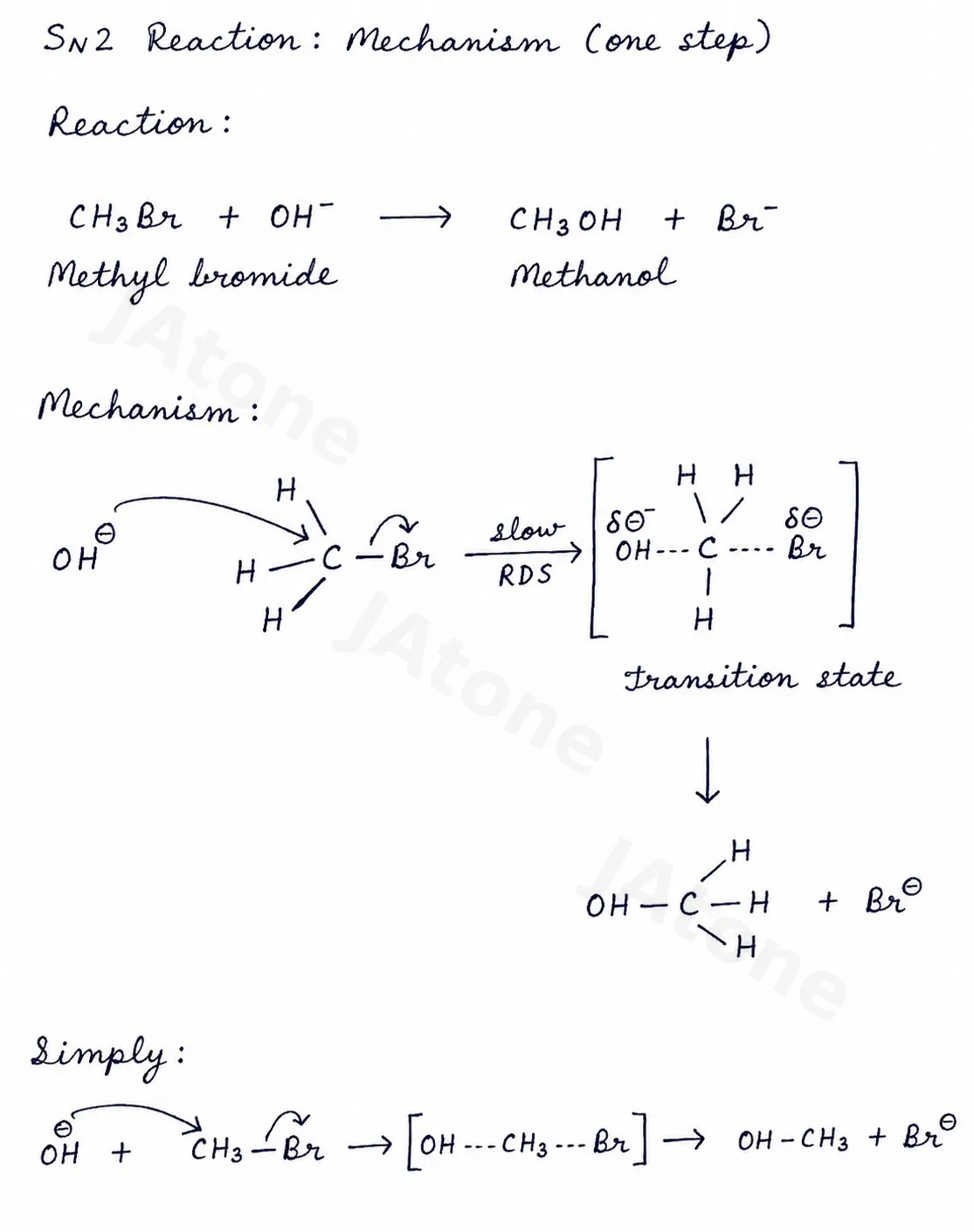
    SN2 Reaction Mechanism — Backside Attack and Walden Inversion
  • The Sₙ2 mechanism involves a single, continuous step where bond-breaking and bond-making occur simultaneously.
  • Backside Attack: The nucleophile attacks the carbon atom bearing the leaving group from the side directly opposite (180°). This approach is favored because both the nucleophile and the leaving group are electron-rich and repel each other.
  • Transition State: A high-energy transition state forms where the central carbon is partially bonded to both the incoming nucleophile and the outgoing leaving group (pentacoordinate).
  • Inversion of Configuration: The backside attack forces the other three groups on the carbon to "flip" to the other side — Walden Inversion.
  • Factors Favoring Sₙ2 Reactions:

  • Substrate: Fastest for minimal steric hindrance. Reactivity: Methyl > Primary (1°) > Secondary (2°) >> Tertiary (3°) (unreactive).
  • Nucleophile: A strong, negatively charged nucleophile (e.g., OH⁻, CN⁻, I⁻).
  • Leaving Group: A good leaving group (weak base) is essential (e.g., I⁻, Br⁻, TsO⁻).
  • Solvent: Polar aprotic solvents (e.g., acetone, DMSO, DMF) are preferred.
  • The Sₙ1 Reaction (Substitution Nucleophilic Unimolecular)

  • The Sₙ1 reaction is a two-step process. The term "unimolecular" signifies that the rate-determining step involves only one molecule: the substrate.
  • Rate = k[Substrate]

    Sₙ1 Mechanism

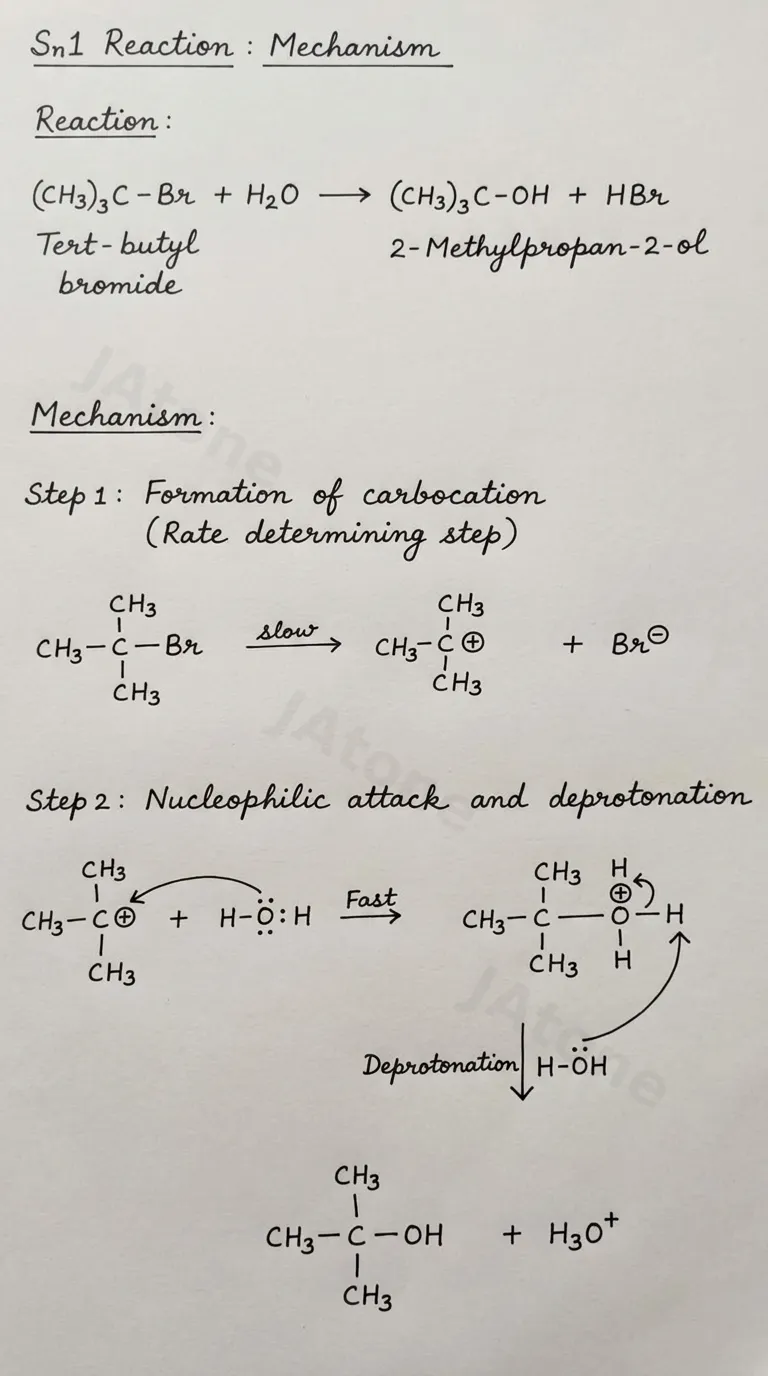
    SN1 Reaction Mechanism — Carbocation Intermediate
  • The Sₙ1 mechanism proceeds through a carbocation intermediate.
  • Step 1 — Formation of a Carbocation (Slow, Rate-Determining): The bond between the carbon and the leaving group breaks heterolytically. The leaving group departs with the electron pair, forming a planar, sp²-hybridized carbocation intermediate.
  • Step 2 — Nucleophilic Attack (Fast): The nucleophile attacks the electron-deficient carbocation. Since the carbocation is planar, the nucleophile can attack from either face with equal probability.
  • Stereochemistry in Sₙ1

  • Because the nucleophilic attack can occur from either side of the planar carbocation, if the starting material is chiral, the Sₙ1 reaction typically leads to racemization — a nearly 50:50 mixture of two enantiomers (R and S).
  • Factors Favoring Sₙ1 Reactions:

  • Substrate: Fastest for substrates that form stable carbocations. Order: Tertiary (3°) > Secondary (2°) >> Primary (1°) & Methyl (unreactive).
  • Nucleophile: A weak, neutral nucleophile (e.g., H₂O, ROH) is typically used.
  • Leaving Group: A very good leaving group is required to facilitate departure in the first step.
  • Solvent: Polar protic solvents (e.g., water, ethanol) stabilize the carbocation intermediate.
  • Comparison Table: Sₙ1 vs. Sₙ2

    FeatureSₙ1 ReactionSₙ2 Reaction
    MolecularityUnimolecularBimolecular
    KineticsRate = k[Substrate]Rate = k[Substrate][Nucleophile]
    MechanismTwo stepsOne concerted step
    IntermediateCarbocation formedNo intermediate
    Substrate Reactivity3° > 2° >> 1°Methyl > 1° > 2° >> 3°
    NucleophileWeak favoredStrong required
    StereochemistryRacemizationInversion
    SolventPolar proticPolar aprotic
    Read next →E1 & E2 EliminationGrignard ReagentFunctional Groups
    • SN1: Rate = k[Substrate] — 2 steps, unimolecular
    • SN2: Rate = k[S][Nu] — concerted backside attack
    • SN1 → racemization; SN2 → Walden inversion
    • SN2 favors methyl/1°; SN1 favors 3° substrates
    • SN2: polar aprotic solvent; SN1: polar protic
    Contents
    The Sₙ2 Reaction (Substitution Nucleophilic Bimolecular)Sₙ2 MechanismFactors Favoring Sₙ2 Reactions:The Sₙ1 Reaction (Substitution Nucleophilic Unimolecular)Sₙ1 MechanismStereochemistry in Sₙ1Factors Favoring Sₙ1 Reactions:Comparison Table: Sₙ1 vs. Sₙ2

    Available Files5

    These original educational materials were created by Juber Aktar for JAtone. They are hosted on Google Drive or Google Slides for convenient access. Any future advertising will remain outside this file list and separate from the Preview and Download controls.

    SN1 and SN2 Reactions: A Comprehensive Guide

    Presentation
    Organic Chemistry
    PreviewDownload

    SN1 & SN2 Mechanisms: Professional Series

    PDF Document
    Organic Chemistry
    PreviewDownload

    SN1 vs SN2: Energy Profile & Transition States

    Visual Diagram
    Organic Chemistry
    PreviewDownload

    SN1 & SN2 Reactions: YouTube Lecture Notes

    PDF Document
    Organic Chemistry
    PreviewDownload

    SN1 / SN2 Mechanism Visualization

    Visual Diagram
    Organic Chemistry
    PreviewDownload

    About SN1 & SN2 Reactions: Mechanism, Differences & Notes PDF

    SN1 & SN2 Reactions: Mechanism, Differences & Notes PDF is a fundamental concept in organic chemistry. Understanding the mechanisms, reaction conditions, and stereo-chemical outcomes is crucial for mastering organic chemistry. Our curated resources provide step-by-step visualizations to help you excel.

    JAtone.
    JAtone.

    Premium, beautifully crafted visual guides and presentations for your academic journey. Let's grow together.

    STUDIO

    • About JAtone
    • Contact Us
    • Functional Group Explorer

    LEGAL

    • Privacy Policy
    • Terms of Service

    © 2026 JAtone. Cultivated for Students.

    PrivacyTerms

    SELF TEST

    Practice MCQs

    Question 1 / 5Score: 0

    What is the rate-determining step of an SN1 reaction?

    LEARNING SUPPORT

    SN1
    & SN2 Reactions: Mechanism, Differences & Notes PDF FAQ

    What is the difference between SN1 and SN2?

    The rate depends on the substrate. Primary substrates undergo SN2 faster, while tertiary substrates undergo SN1 faster. Generally, SN2 reactions can be very fast because they are concerted, provided there is minimal steric hindrance.

    Polar protic solvents (like water, alcohols) favor SN1 reactions because they can hydrogen-bond and stabilize both the carbocation intermediate and the leaving group.

    SN2 stands for Substitution Nucleophilic Bimolecular.

    How to know if it is SN1 or SN2?

    It depends heavily on the substrate and conditions. SN2 is faster for methyl and primary substrates. SN1 is faster (and SN2 does not occur) for tertiary substrates.

    Look for a tertiary substrate, a weak nucleophile (like H2O or ROH), and a polar protic solvent. These conditions strongly favor the SN1 pathway.

    Look for a primary or methyl substrate, a strong negatively-charged nucleophile, and a polar aprotic solvent. These conditions strongly favor the SN2 pathway.

    What does SN1 stand for?

    SN2 is a 1-step concerted reaction. SN1 is a 2-step reaction.

    SN1 stands for Substitution Nucleophilic Unimolecular. It means it is a substitution reaction where the rate-determining step involves only one molecule (the substrate breaking apart).

    Is SN2 first or second order?

    No, SN1 is a first-order reaction overall (Rate = k[Substrate]). SN2 is a second-order reaction (Rate = k[Substrate][Nucleophile]).

    SN2 strongly prefers primary substrates over secondary substrates because primary carbons have much less steric hindrance, allowing the nucleophile to attack more easily.

    Because the rate-determining step is a single concerted step involving the collision of two molecules: the nucleophile and the substrate. Thus, the rate depends on the concentrations of both.