Ester Hydrolysis MechanismsAlkaloids OverviewAlkaloid Structure MethodsStructure Elucidation of NicotineIntroduction to DrugsClassification of Drugs: PharmacodynamicsWhy Do We Take Paracetamol in Fever?Types of SolventsSustainable SolventsNucleophile and ElectrophileReactions of MaltoseFunctional GroupsSN1 and SN2 ReactionsGrignard ReagentE1 and E2 Elimination
Corrosion OverviewVSEPR TheoryBond Angle Deviations in VSEPRVSEPR Theory and Molecular PolarityLewis Structures, Formal Charge & ResonanceLewis Dot StructureSuperacids and Liquid AmmoniaTypes of ReactionsAdvanced Types of ReactionsPeriodic Trends (Periodicity)Hydrogen BondingRoasting and CalcinationRelativistic Effects in Heavy Metals
Ajanta Cave PaintingsChemical Principles of Food PreservationAncient Indian Methods of Food PreservationChemicals Used in Food PreservationHow were clothes dyed?Ancient Indian Glass and Ceramic TechnologyAncient Indian MetallurgyAncient Chemistry of Cosmetics & Perfumery
Conductometric Titration: Strong Acid vs. Strong BaseArrhenius EquationQuantum YieldStates of MatterWeston Standard CellElectrochemistry
Chemistry Studio
Functional Group ExplorerChemical Structure Editor

JAtone.

Notes & guides

Learn
Ester Hydrolysis MechanismsAlkaloids OverviewAlkaloid Structure MethodsStructure Elucidation of NicotineIntroduction to DrugsClassification of Drugs: PharmacodynamicsWhy Do We Take Paracetamol in Fever?Types of SolventsSustainable SolventsNucleophile and ElectrophileReactions of MaltoseFunctional GroupsSN1 and SN2 ReactionsGrignard ReagentE1 and E2 Elimination
Corrosion OverviewVSEPR TheoryBond Angle Deviations in VSEPRVSEPR Theory and Molecular PolarityLewis Structures, Formal Charge & ResonanceLewis Dot StructureSuperacids and Liquid AmmoniaTypes of ReactionsAdvanced Types of ReactionsPeriodic Trends (Periodicity)Hydrogen BondingRoasting and CalcinationRelativistic Effects in Heavy Metals
Ajanta Cave PaintingsChemical Principles of Food PreservationAncient Indian Methods of Food PreservationChemicals Used in Food PreservationHow were clothes dyed?Ancient Indian Glass and Ceramic TechnologyAncient Indian MetallurgyAncient Chemistry of Cosmetics & Perfumery
Conductometric Titration: Strong Acid vs. Strong BaseArrhenius EquationQuantum YieldStates of MatterWeston Standard CellElectrochemistry
Chemistry Studio
Functional Group ExplorerChemical Structure Editor

JAtone.

Notes & guides

Learn
J
JAtone
Homeinorganic chemistry
|

Hydrogen Bonding: Types, Examples & Diagrams PDF

  • X–H ···Y (X, Y = N, O, F): δ⁺H attracts lone pair
  • Intermolecular → raises B.P., M.P. & viscosity
  • Intramolecular → chelate ring; no B.P. rise
  • H₂O: 2 donor + 2 acceptor → extensive 3D network
  • ~5–30 kJ/mol: stronger than vdW, weaker than covalent
What is a Hydrogen Bond (H-Bond)?How an H-Bond Forms1. Intermolecular Hydrogen BondExample 1 — Water (H₂O)Example 2 — Hydrogen Fluoride (HF)Example 3 — Ammonia (NH₃)Example 4 — Acetic Acid Dimer2. Intramolecular Hydrogen BondExample 1 — o-NitrophenolExample 2 — Salicylic AcidComparison Table: Intermolecular vs. Intramolecular H-Bond

What is a Hydrogen Bond (H-Bond)?

  • A Hydrogen Bond is a special type of dipole–dipole electrostatic attraction.
  • It forms when a Hydrogen atom that is covalently bonded to a highly electronegative atom (Fluorine, Oxygen, or Nitrogen) is attracted to the lone pair of electrons of another electronegative atom nearby.
  • How an H-Bond Forms

  • 1.The electronegative atom (X) pulls the shared electron pair toward itself, becoming partially negative (δ⁻).
  • 2.The Hydrogen atom, stripped of electron density, becomes partially positive (δ⁺).
  • 3.This δ⁺ Hydrogen atom is then electrostatically attracted to the lone pair of a neighbouring electronegative atom (Y).
  • General notation: X–H · · · Y (where X and Y = N, O, or F)
  • Bond strength: Stronger than van der Waals forces, but weaker than a covalent bond (~5–30 kJ/mol).
  • 1. Intermolecular Hydrogen Bond

  • An Intermolecular H-bond is formed between two or more different molecules (of the same or different compounds).
  • It results in the association of molecules, which increases boiling point, melting point, viscosity, and surface tension.
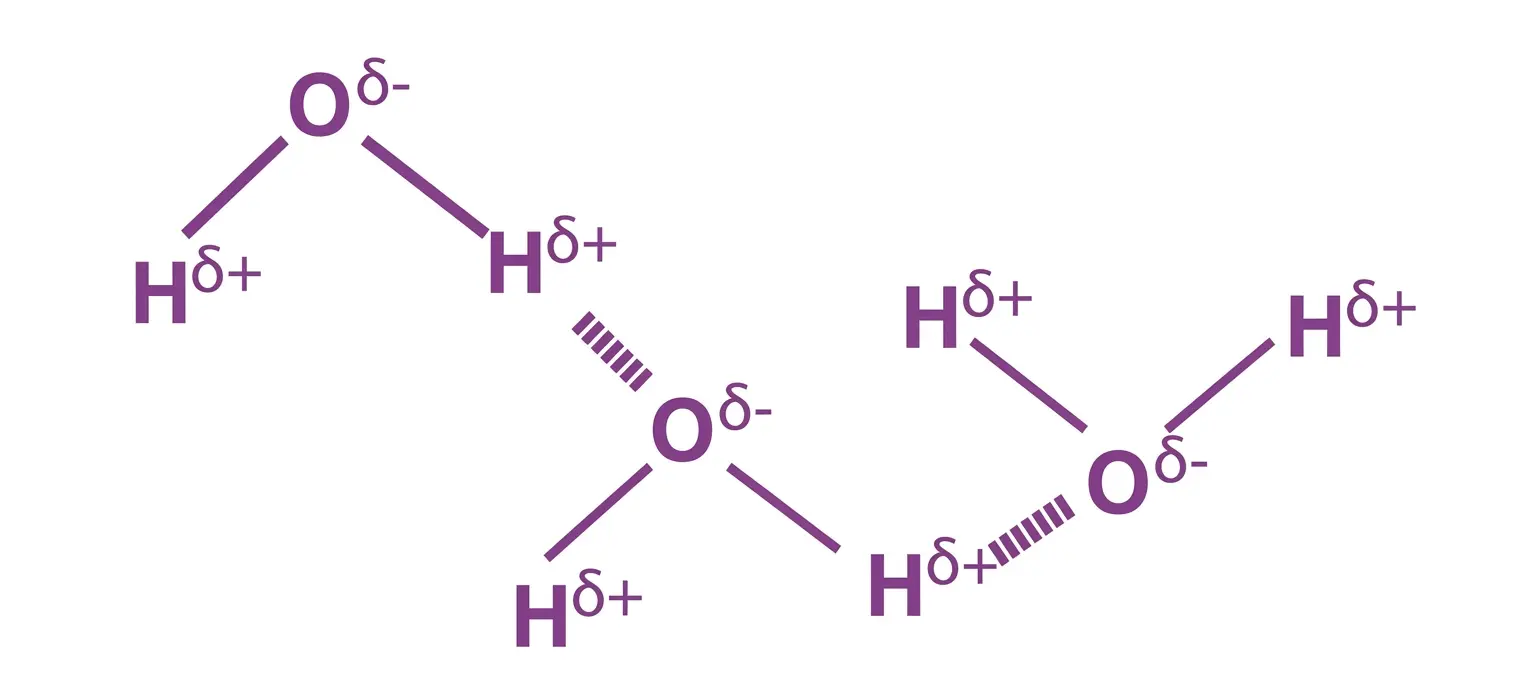
  • Example 1 — Water (H₂O)

    Water (H₂O) Hydrogen Bond Network — Intermolecular
  • Each water molecule can donate two H-bonds and accept two H-bonds, forming an extensive 3D tetrahedral network. This explains why:
  • Water is a liquid at room temperature (unusually high boiling point for its molecular mass).
  • Ice is less dense than liquid water (the open H-bond lattice expands volume).
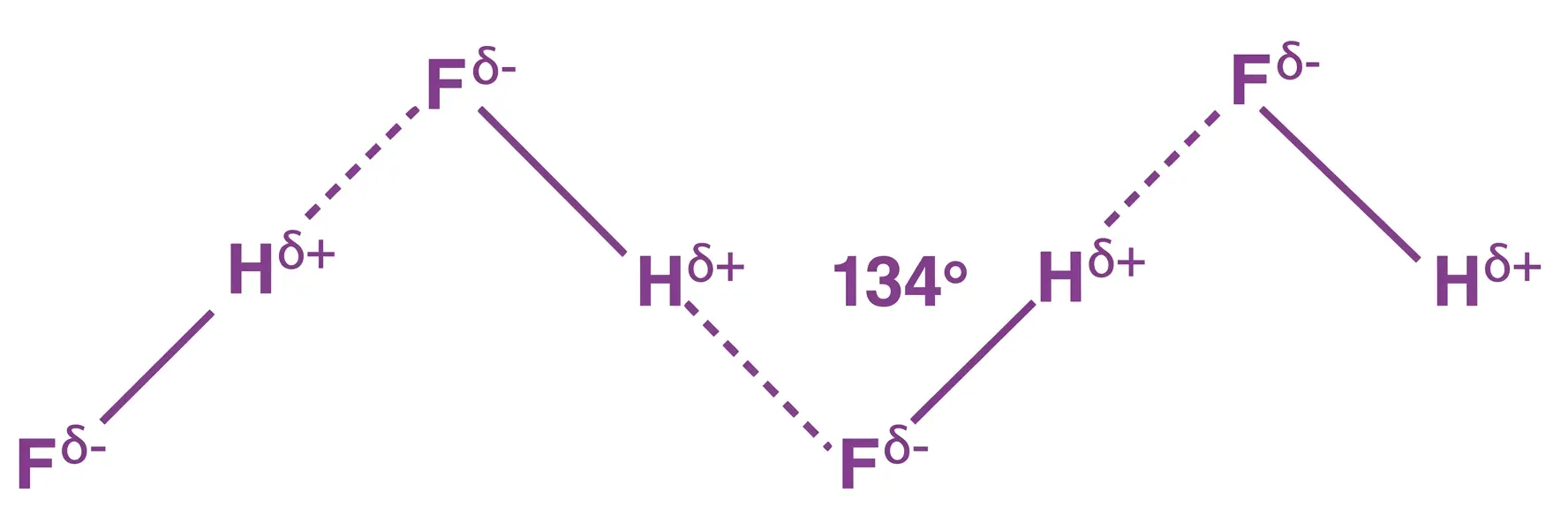
  • Example 2 — Hydrogen Fluoride (HF)

    Hydrogen Fluoride (HF) — Zig-Zag Chain via H-bonds
  • Due to the exceptionally high electronegativity of Fluorine, HF molecules associate strongly. In the solid and liquid states, HF adopts a zig-zag chain arrangement due to the tetrahedral geometry around each F atom. It exists as (HF)ₙ polymeric clusters.
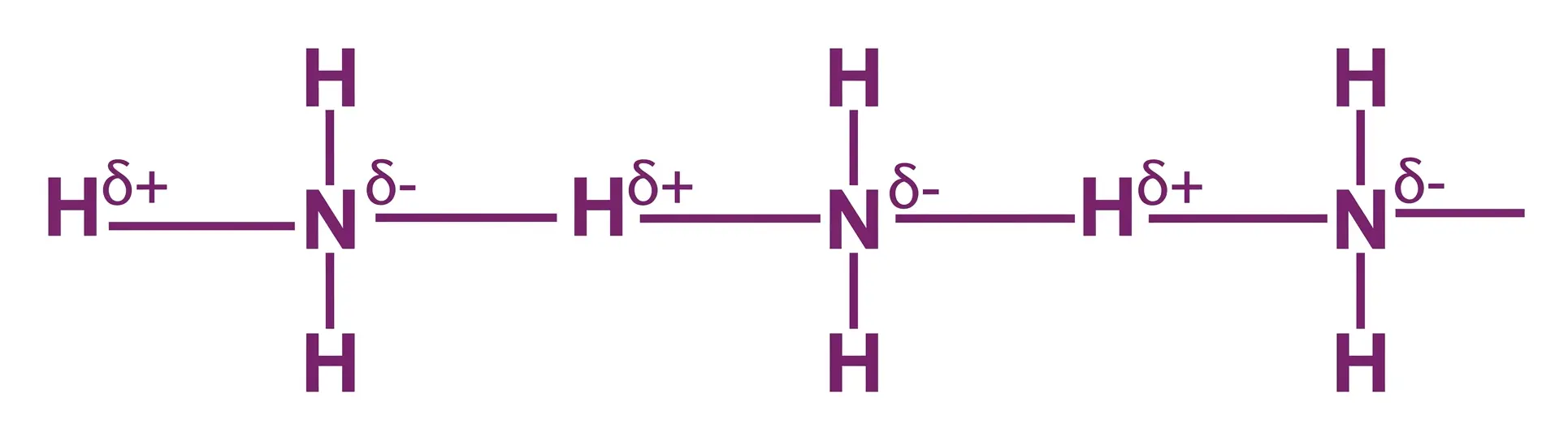
  • Example 3 — Ammonia (NH₃)

    Ammonia (NH₃) — Intermolecular Hydrogen Bonding
  • The H–N bond in ammonia is polar. H-bonds form between the δ⁺ Hydrogen of one NH₃ molecule and the lone pair of Nitrogen on an adjacent NH₃ molecule. This association contributes to ammonia's relatively high boiling point (−33°C) compared to phosphine (PH₃, −87°C).
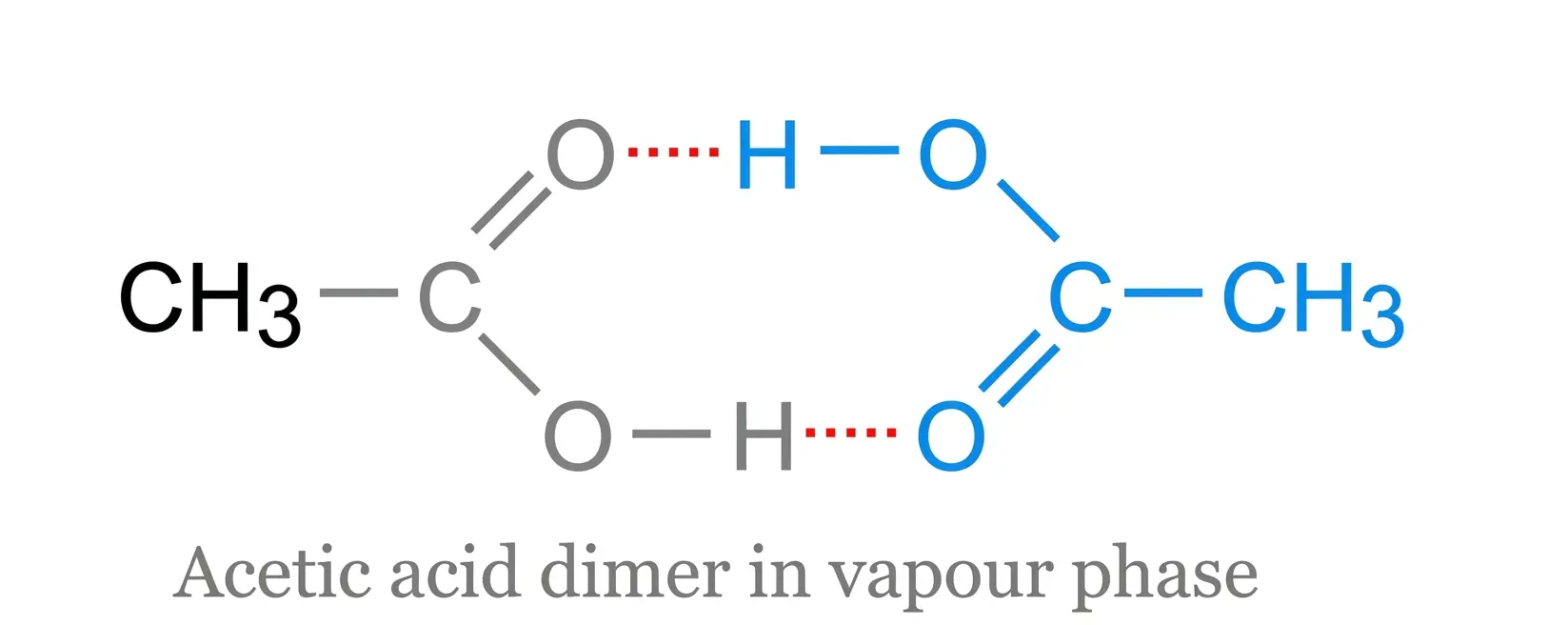
  • Example 4 — Acetic Acid Dimer

    Acetic Acid Dimer — Cyclic Intermolecular H-Bond
  • Two molecules of acetic acid join together via two simultaneous H-bonds to form a stable, closed-ring dimer. This cyclic dimer structure is so stable that acetic acid exists largely as dimers in the vapour phase and in non-polar solvents.
  • 2. Intramolecular Hydrogen Bond

  • An Intramolecular H-bond is formed within a single molecule — between a H-donor and a H-acceptor group present in the same molecule.
  • This requires the two groups to be in close geometric proximity. It often leads to the formation of a stable ring structure (chelation) and has no effect on boiling point (in contrast to intermolecular H-bonds).
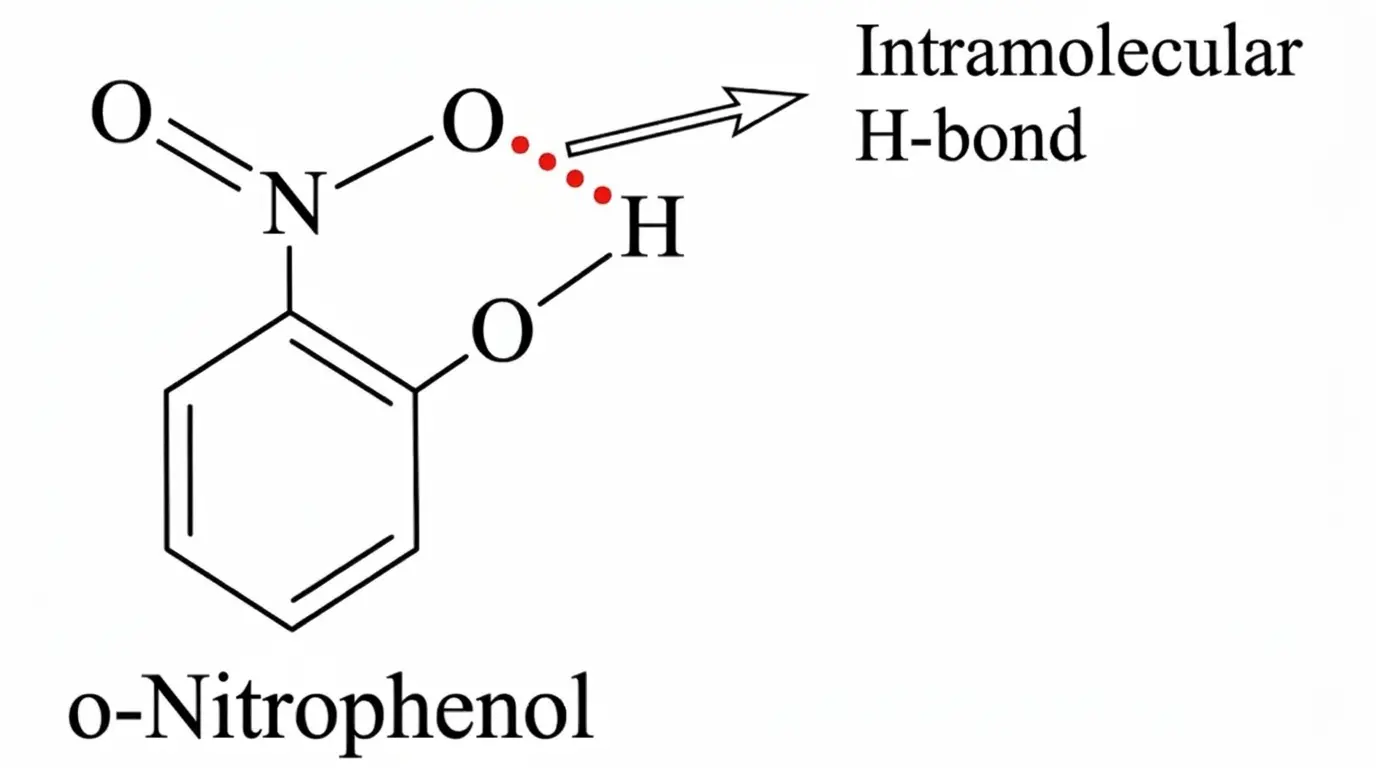
  • Example 1 — o-Nitrophenol

    o-Nitrophenol — Intramolecular H-Bond forming a 6-membered ring
  • In o-Nitrophenol, the H atom of the –OH group forms a six-membered ring H-bond with one of the Oxygen atoms of the –NO₂ group attached to the adjacent position of the benzene ring. Because the H-bond is locked intramolecularly, o-nitrophenol has a much lower boiling point than its p-nitrophenol isomer (which uses intermolecular H-bonds instead).
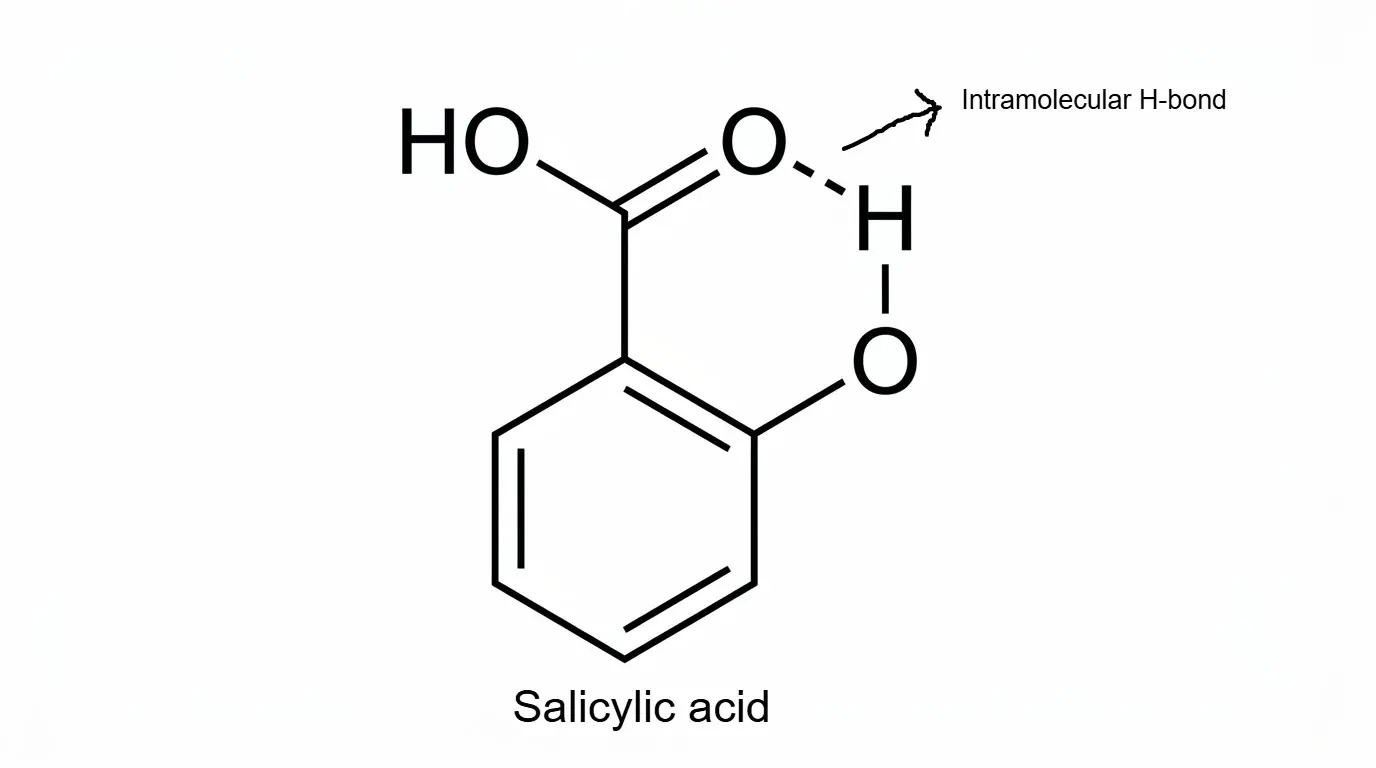
  • Example 2 — Salicylic Acid

    Salicylic Acid — Intramolecular H-Bond between –OH and –COOH
  • In Salicylic Acid, an intramolecular H-bond forms between the –OH (hydroxyl) group and the –COOH (carboxyl) group within the same molecule. This produces a stable six-membered chelate ring, reducing its ability to associate with other molecules and lowering its solubility compared to similar compounds.
  • Comparison Table: Intermolecular vs. Intramolecular H-Bond

    FeatureIntermolecular H-BondIntramolecular H-Bond
    LocationBetween two or more moleculesWithin a single molecule
    Effect on B.P./M.P.Increases (molecular association)No significant increase
    Molecular massAppears higher (associates)No association effect
    SolubilityHigher in polar solventsGenerally lower
    Ring formationNoYes (chelation)
    ExampleH₂O, HF, NH₃o-Nitrophenol, Salicylic Acid
    Read next →Periodic TrendsVSEPR Theory
    • X–H ···Y (X, Y = N, O, F): δ⁺H attracts lone pair
    • Intermolecular → raises B.P., M.P. & viscosity
    • Intramolecular → chelate ring; no B.P. rise
    • H₂O: 2 donor + 2 acceptor → extensive 3D network
    • ~5–30 kJ/mol: stronger than vdW, weaker than covalent
    Contents
    What is a Hydrogen Bond (H-Bond)?How an H-Bond Forms1. Intermolecular Hydrogen BondExample 1 — Water (H₂O)Example 2 — Hydrogen Fluoride (HF)Example 3 — Ammonia (NH₃)Example 4 — Acetic Acid Dimer2. Intramolecular Hydrogen BondExample 1 — o-NitrophenolExample 2 — Salicylic AcidComparison Table: Intermolecular vs. Intramolecular H-Bond

    Available Files2

    These original educational materials were created by Juber Aktar for JAtone. They are hosted on Google Drive or Google Slides for convenient access. Any future advertising will remain outside this file list and separate from the Preview and Download controls.

    Hydrogen Bonding: Types & Examples (Presentation)

    Presentation
    Inorganic Chemistry
    PreviewDownload

    Hydrogen Bonding: Study Notes (PDF)

    PDF Document
    Inorganic Chemistry
    PreviewDownload

    About Hydrogen Bonding: Types, Examples & Diagrams PDF

    Hydrogen Bonding: Types, Examples & Diagrams PDF is a fundamental concept in inorganic chemistry. Understanding the mechanisms, reaction conditions, and stereo-chemical outcomes is crucial for mastering organic chemistry. Our curated resources provide step-by-step visualizations to help you excel.

    JAtone.
    JAtone.

    Premium, beautifully crafted visual guides and presentations for your academic journey. Let's grow together.

    STUDIO

    • About JAtone
    • Contact Us
    • Functional Group Explorer

    LEGAL

    • Privacy Policy
    • Terms of Service

    © 2026 JAtone. Cultivated for Students.

    PrivacyTerms

    SELF TEST

    Practice MCQs

    Question 1 / 5Score: 0

    Which atoms must be involved for a hydrogen bond to form?

    LEARNING SUPPORT

    Hydrogen
    Bonding: Types, Examples & Diagrams PDF FAQ

    A hydrogen bond forms when a hydrogen atom is covalently bonded to a highly electronegative atom (like Fluorine, Oxygen, or Nitrogen) and is attracted to a lone pair on another electronegative atom.

    It significantly increases boiling point. The strong intermolecular attraction between molecules requires more thermal energy to break, which is why water (H2O) has a much higher boiling point than hydrogen sulfide (H2S).

    Intermolecular hydrogen bonding occurs between different molecules (e.g., between two water molecules). Intramolecular hydrogen bonding occurs within the same molecule (e.g., in o-nitrophenol), often forming a stable ring structure.